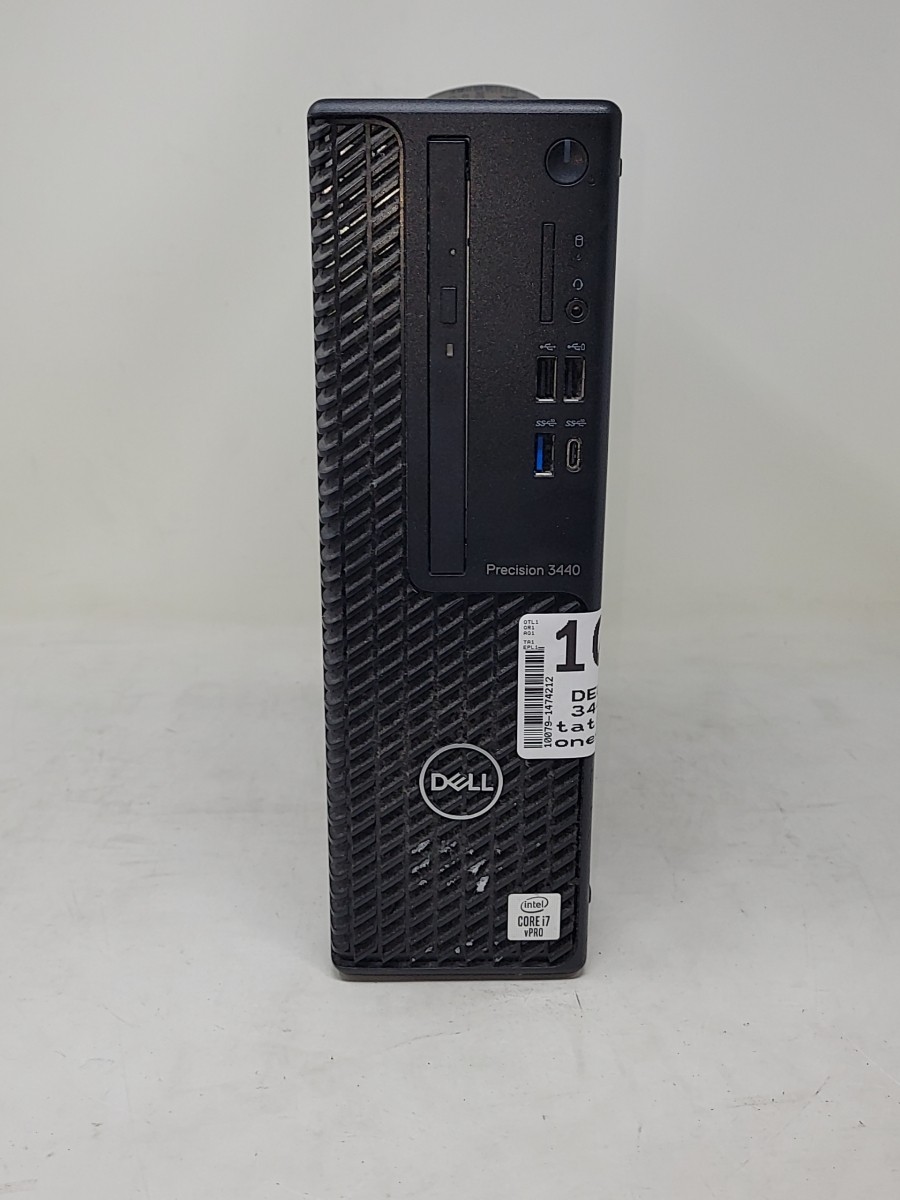
DELL PRECISION 3440 SFF Workstation PC Barebones SEE NOTES

Seller: rawko (99.6% positive feedback)
Location: US
Condition: For parts or not working
Price: 75.99 USD
Buy It Now
#Sponsored
In the ever-evolving landscape of professional computing, form factors that blend compact design with robust performance are in high demand. The Dell Precision 3440 SFF (Small Form Factor) Workstation PC Barebones offers a compelling option for professionals who need a reliable, space-efficient platform that can be tailored to specialized workloads. This article examines the key considerations, potential configurations, and practical advantages of adopting a barebones approach with the 3440 SFF.
Overview and Core Concept The Dell Precision 3440 SFF is designed to maximize workflow efficiency within constrained workspace environments. As a barebones system, it provides the essential chassis and foundational architecture, inviting customization through the addition of memory, storage, graphics, and other components to meet specific professional requirements. This approach enables users to align the workstation with their unique applications—whether they are engineering simulations, 3D rendering, data analysis, or content creation—without paying for components that may not be necessary for every user.
Key Design and Build Considerations – Size and ergonomics: The SFF form factor emphasizes a reduced footprint, which is advantageous for desk setups, lab benches, or studio environments where space is at a premium. Its compact dimensions can simplify cable management and improve overall ergonomics. – Expandability: Although compact, the barebones model typically supports essential upgrades in memory, storage, and graphics options. Prospective buyers should review the exact memory slots, PCIe expansion opportunities, and available bays to ensure compatibility with their desired workloads. – Thermal management: Sustained performance in small form factors depends on efficient cooling. Users should consider airflow within their workspace and the potential need for additional cooling strategies to maintain stable operation under load. – Reliability and serviceability: Dell’s Precision line emphasizes hardware reliability and professional-grade components. For users who rely on uninterrupted throughput, evaluating warranty terms, be-on-site service options, and ease of component replacement is prudent.
Deployment Use Cases – Engineering and CAD workflows: The Precision 3440 SFF can serve as a compact workstation for CAD software, simulation tools, and design visualization when paired with an appropriate CPU, GPU, and memory configuration. – Data analysis and scientific computing: With sufficient RAM and fast storage, the system can handle large datasets, analytical workloads, and visualization tasks in a space-conscious setup. – Multimedia production: For editors and creators working with HD to 4K timelines, a suitable GPU and fast storage array can deliver smoother playback and faster rendering, all within a desktop footprint that fits tighter studios.
Configuration Guidance (Barebones Approach) – Processor: Select a capable workstation-grade CPU that suits the workload profile, balancing core count, clock speed, and thermal headroom. Consider recent generation CPUs that offer improved performance-per-watt characteristics. – Memory: Plan for ample ECC (if supported) or non-ECC RAM depending on reliability requirements and software compatibility. Determine the number of DIMMs and target capacity to meet peak project needs. – Storage: Choose a combination of fast NVMe SSDs for system and software, along with larger HDDs or SATA SSDs for data repositories. Ensure the motherboard supports the desired drive types and RAID configurations if applicable. – Graphics: A professional-grade GPU may be essential for CAD, 3D rendering, and complex visualizations. Confirm compatibility with the chassis, power supply, and drivers for the intended applications. – Power and cooling: Verify the power supply wattage and efficiency, as well as the thermal design limits of the SFF enclosure. Depending on the workload, a higher-efficiency PSU and active cooling strategies could be beneficial. – Peripherals and expandability: Assess whether additional PCIe cards, storage bays, or I/O expansion cards are necessary for specialized workflows, and ensure the barebones chassis accommodates them.
Operational Considerations and Best Practices – Software optimization: Align the software stack with the hardware configuration. This includes selecting compatible drivers, optimizing rendering and computation kernels, and leveraging hardware acceleration when available. – Maintenance planning: Establish a routine for firmware and driver updates, backup strategies, and periodic thermal checks to sustain peak performance over the system’s lifecycle. – Security and compliance: For professional environments, incorporate access controls, secure boot, and encryption features as required by the organization’s governance standards.
Conclusion The Dell Precision 3440 SFF Workstation PC Barebones represents a strategic option for professionals who require a small-footprint workstation without paying for unused components. When configured thoughtfully, it can deliver reliable, scalable performance across demanding workloads while preserving valuable workspace. By selecting compatible components that align with the intended use case and maintaining disciplined maintenance practices, users can achieve a balanced, efficient, and durable solution that meets the rigors of modern professional computing.